Function: the atomic unit of code
The First Nine Guide. Block 1

Functions are the basic unit of every application. Requests call functions; some are fast, some are slow. To reason about performance, I classify functions by a few traits:
- Algorithmic complexity.
- Resource profile.
- Concurrency safety.
Let's go in order.
Algorithmic complexity
A function is a building block of performance. The first and roughest estimate of its behavior is Big-O.
Before you roll your eyes: no heavy math here. To analyze slow code you only need to:
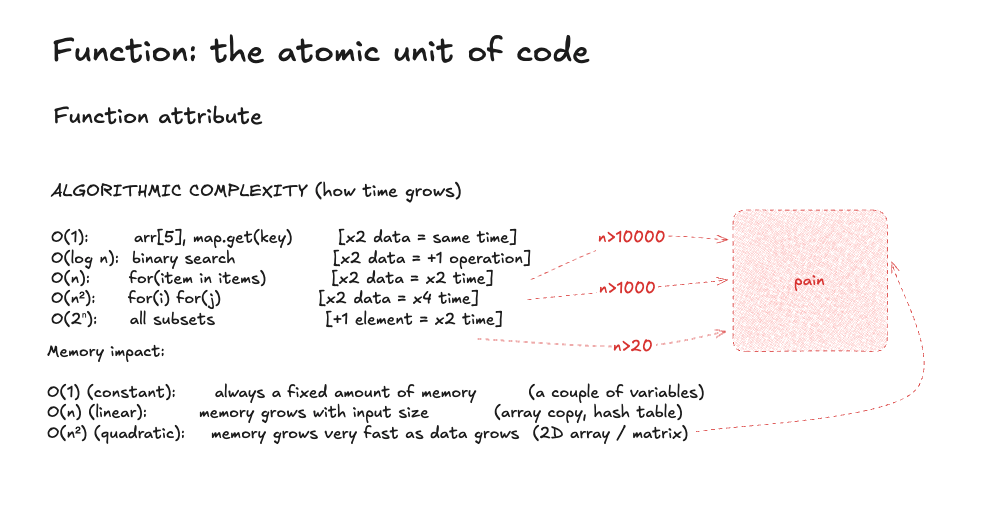
- tell O(1) from O(n^2)
- understand that O(n log n) is the boundary; beyond it there is only pain
- notice when an algorithm suddenly becomes O(n!)
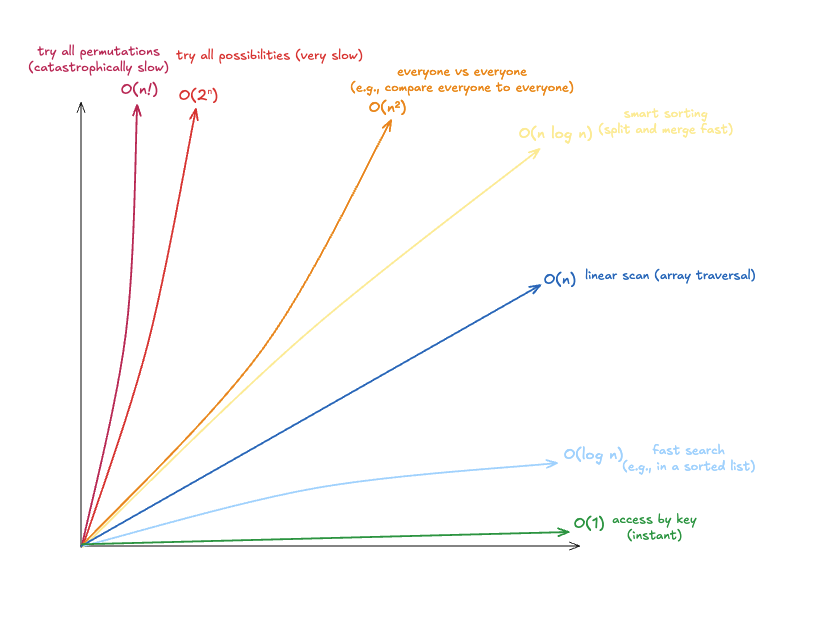
Above the yellow line performance starts degrading as data volume grows.
Here are examples and thresholds for n (I do not have real-life examples of O(n!)):
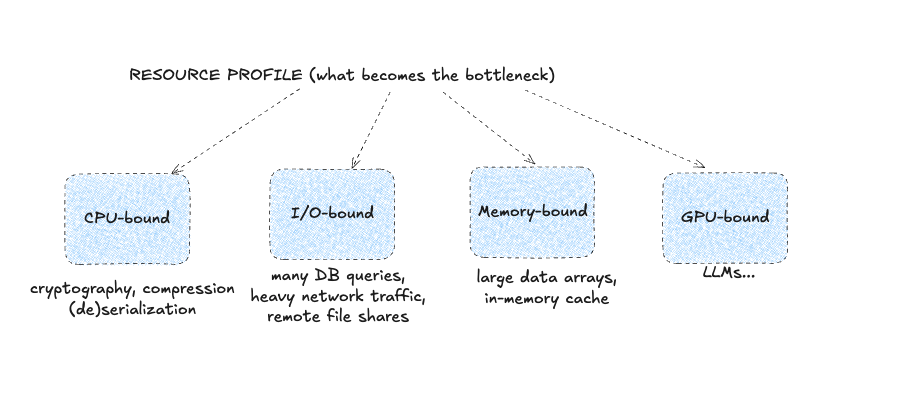
Resource profiles
Speed is not the whole story; we're doing performance engineering.
Some functions wait on disk, network, or cache. Others burn CPU.
Classify functions early (ideally while writing them):
- IO-bound - waits on network, disk, or DB
- CPU-bound - parses and computes
- Memory-bound - pulls data from RAM without heavy CPU
- GPU-bound - obviously, uses GPU
This tells you where the bottleneck hides: CPU, memory, socket, or the algorithm itself.
Concurrency safety
If code runs in parallel - and it almost always does - ask two questions:
- will we corrupt shared data?
- will we block our neighbors?
Three categories:
- Thread-safe - can be called from any thread
- Thread-unsafe - can break everything
- Conditionally safe - safe only under certain conditions
Thread-safe:
- Works with immutable data.
- Has no shared mutable state.
- Synchronizes access to shared data (locks).
- Uses atomic operations.
Thread-unsafe:
- Mutates global state.
- Uses static mutable variables.
- Does non-atomic read-modify-write.
- Examples: strtok() in C, SimpleDateFormat in Java.
Conditionally safe:
- Safe under external synchronization.
- Read-only operations on shared data.
Call overhead
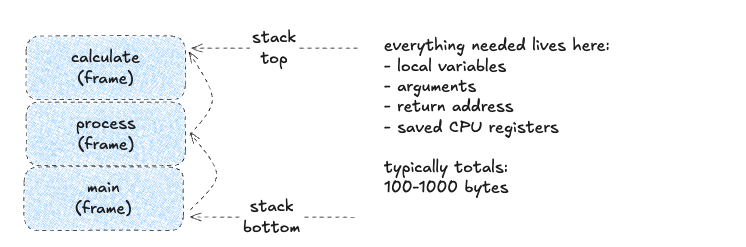
Every function call allocates its own memory region called a stack frame.
Each call creates a new frame at the top of the stack; when the function completes, the frame is removed. Even int sum(int a, int b) costs 16-64 bytes of overhead.
Why should you care?
Simple:
- Creating a stack frame takes 10-50 CPU cycles (fast, but it hurts in tight loops).
The deeper a function sits in a call chain, the more expensive it becomes (hello, stack overflow). Lambdas and anonymous functions are even pricier.
Dirty hack: inline functions. They remove the frame cost, but try/catch/finally breaks inlining.
Common traps (take them with you)
Loops:
- String concatenation in a loop (str += char often becomes O(n^2)).
- Nested loops over large collections (especially unbounded ones).
Stack overflow risk:
- Each call creates a stack frame (~100-1000 bytes).
- Deep recursion will exhaust the stack (~1 MB by default).
Hybrid-bound functions:
- Blocking I/O inside CPU functions is hard to debug and scale. Avoid it.
Next up: a breakdown of runtime models.
Follow the channel @r9yo11yp9e - we will keep chasing the nines.